


It usually starts small. A calf that’s been tight for three weeks and isn’t loosening. A shoulder that clicks after every session. A tendon that flares up the same way, at the same mile, every single run. Somewhere around week two of feeling stuck, a lot of people end up exactly where you might be right now: on a forum thread or a podcast clip, reading the words BPC-157 or TB-500 for the first time, wondering if this is the thing that finally gets them unstuck.
This piece is for that person. Not the biohacker who’s already decided, and not the skeptic who’s already dismissed it, but the person somewhere in the middle who wants an honest answer to two very different questions. The first is whether these peptides actually heal anything. The second, quieter question is who you’d even trust to help you try one safely, if you decided it made sense. Most articles online answer neither question well. This one tries to answer both, in order, and doesn’t pretend the science is further along than it is.
Last updated June 2026. The recovery peptides discussed here are not FDA-approved drugs for healing injuries. The human evidence for most of them is limited and early, and several are prohibited in competitive sport. Where they’re accessed responsibly, it’s through a prescription and a licensed compounding pharmacy, not a vial that shows up from a research-chemical website with no name attached to it.
Who this is actually for
If you’re an athlete who competes under drug testing, some of this doesn’t apply to you at all, and you’ll want to skip ahead to the section on sport. If you’re someone managing a stubborn soft-tissue injury who’s curious about the science and cautious about the marketing, this is written for you specifically. And if you’ve already added something to a cart on a research-chemical site and you’re having second thoughts, that instinct is worth listening to before you finish the purchase.
What the science actually says
Here’s the part that matters most, stated plainly: the mechanisms behind these peptides are genuinely interesting, and the animal research is often encouraging. But the human evidence, the kind that would let anyone honestly say “this works for people,” mostly hasn’t been done yet. That gap between promising biology and proven treatment is where all the marketing lives, so it helps to walk through each compound on its own terms.
BPC-157: the one everyone’s heard of
BPC-157 comes from a sequence found in human gastric juice, and researchers have studied it for tissue repair in the gut, tendons, ligaments, and muscle. In a controlled rat study published in the Journal of Orthopaedic Research, it helped Achilles tendon-to-bone healing and even counteracted the damage a corticosteroid injection causes, with the treated animals showing better structure and function [1]. That’s a genuinely clean result, and it’s exactly the kind of finding that earns a compound the right to be tested in humans next.
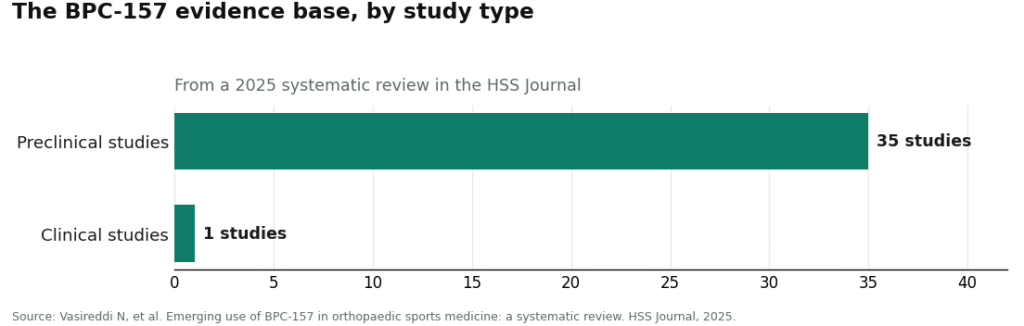
But that testing mostly hasn’t happened. A 2025 systematic review in the HSS Journal went looking for the human evidence and found 36 total studies on BPC-157. Thirty-five were preclinical. One was a small clinical study. The reviewers stated outright that no clinical safety data were found [2]. Sit with that for a second: the most talked-about recovery peptide on the internet has, by the most recent count, exactly one small human study behind it. If you strip away everything you’ve read about BPC-157 online, that’s the honest state of the human evidence.
TB-500 and thymosin beta-4: real biology, animal-stage proof
TB-500 is sold as a stand-in for thymosin beta-4, a peptide your body already makes that’s involved in cell migration and tissue repair. The lab work here is legitimate. A 1999 study in the Journal of Investigative Dermatology found that thymosin beta-4 sped up wound healing in rats and helped skin cells migrate faster in lab dishes [3]. A 2004 paper in Nature found it improved heart-muscle cell survival and cardiac function in mice after a coronary injury [4]. Those are meaningful findings about how the molecule behaves in a living system.
They’re just not findings about people. The completed human trials for the recovery uses people actually search for, tendons, muscles, general soft-tissue repair, are essentially nonexistent. TB-500 has a believable mechanism and encouraging animal data. It does not have proof that it works in a person’s shoulder or hamstring, and any seller who implies otherwise is stretching past what the research supports.
There’s also a quieter distinction worth knowing. Thymosin beta-4 is the actual full peptide used in those animal and cell studies [3][4]. TB-500 is a synthetic product marketed under that name, and what actually arrives in an unregulated vial may or may not be the genuine full-length molecule. So the encouraging science belongs to the parent peptide studied in a lab, not to whatever shows up in your mailbox. That distinction is exactly why the source of the product matters as much as the molecule itself.
GHK-Cu: the one with the most human data, and still not a cure
GHK-Cu is a copper-binding peptide your body makes naturally, and it declines as you age. Of the four compounds here, it has the most human-facing research, and that deserves to be said clearly. A 2015 review in BioMed Research International, authored by the scientists who’ve published most extensively on it, describes GHK-Cu as a modulator of skin regeneration that stimulates collagen and influences a wide range of genes, and it includes placebo-controlled human facial-cream studies alongside a large body of animal and cell work [5]. A 2017 analysis in Brain Sciences adds detail on how it seems to reset gene-expression patterns tied to repair [6].
Even here, the caveat matters. Most of that human data comes from skin-cream studies, the trials tend to be small, and the injectable uses people ask about for deeper injury recovery are far less studied than the skin applications. GHK-Cu is the strongest human signal in this group. It’s still not a proven injury treatment, and it shouldn’t be sold as one.
The BPC-157 and TB-500 stack
Combining BPC-157 and TB-500 is probably the single most popular recovery pairing you’ll come across, on the theory that two repair-oriented peptides working through different mechanisms might complement each other. That reasoning isn’t crazy on paper. But there are no human trials of the combination itself proving it’s safe, let alone more effective than either compound alone. You’d be layering two peptides whose individual human evidence is already thin, which makes the combined picture thinner still, not thicker. If you’re going to consider it at all, that’s an argument for more oversight, not less, since now there are two unproven inputs and two chances for something in the vial to not match the label.
If you compete, read this part twice
If you’re a tested athlete, none of this clears you, and that’s not a small print detail. USADA states that BPC-157 is prohibited under the S0 unapproved-substances category of the World Anti-Doping Agency list, because it isn’t approved for human clinical use by any global regulatory authority [7]. Thymosin beta-4 and its derivatives, including TB-500, fall under the growth-factor provisions of that same list. A “research use only” label protects a tested athlete from exactly nothing, and there’s no therapeutic exemption for a substance that isn’t approved as a therapy anywhere in the world. Check your sport’s current prohibited list before you go near any of this.
How to go about it, if you decide to try
This is where the fog usually lifts, because while the science on these compounds is unsettled, the question of who to trust with them isn’t. The compound is roughly the same no matter where you buy it. What actually varies, and what decides whether you get screened, get a real pharmacy, and have someone accountable if something goes wrong, is the provider.
To judge that fairly, here’s the ruler being used, six factors that predict whether a purchase is safe, not whether it’s cheap or convenient.
- Medical oversight. Does a licensed clinician review your history and your specific injury before anything is dispensed, and can they actually tell you no?
- Sourcing and pharmacy. Is the product compounded and dispensed by a licensed pharmacy following real standards, or shipped from a warehouse labeled “research chemical”?
- Testing and approval status. Is purity and identity verified independently, batch by batch, and is the product’s regulatory status stated honestly?
- Honesty about the evidence. Does the provider tell you plainly that the human data is thin, or does the marketing quietly imply a sure thing?
- Regulatory standing. Does the business work inside the prescription-and-pharmacy system, or outside it on a “not for human consumption” label?
- Follow-up. Once you’ve started, can you check in, adjust, and report a problem, or does the relationship end the moment your card clears?
Notice price isn’t on that list. It tells you what you paid, not what you got, and for these compounds the cheap option is cheap precisely because it’s cut every item above out of the process.
One more thing before the rankings, because it should color how you read them. The evidence for these peptides really is limited, as the section above just laid out. That’s not a reason to write the whole category off, and it’s not a reason to treat it casually either. It’s a reason to care more, not less, about who’s standing between you and the vial, because when the science hasn’t caught up yet, the quality of that person is doing a lot of the protective work.
1. FormBlends
FormBlends comes out on top because it’s built around the single thing this market structurally lacks: a licensed clinician between you and the compound, backed by a licensed pharmacy.
- Medical oversight: it’s a physician-supervised telehealth model. A licensed clinician reviews your profile, and access requires a consultation and a prescription, not an add-to-cart button. Clinical services are provided by independent licensed healthcare providers, which means real screening instead of a checkout page dressed up to look like one.
- Sourcing and pharmacy: products are compounded and dispensed by state-licensed 503A compounding pharmacies under recognized standards, with temperature-controlled shipping. That’s a chain of custody a warehouse simply doesn’t have.
- Testing and approval status: FormBlends is upfront that compounded medications are not FDA-approved and haven’t been evaluated by the FDA for safety, effectiveness, or quality, and that they’re not the same as commercially available FDA-approved branded medications. No blurring there.
- Honesty about the evidence: this is where it really separates itself. BPC-157 is described as studied for tissue healing and repair, GHK-Cu as a copper peptide studied for collagen and skin renewal, not as settled cures. A provider willing to be candid about where the evidence is thin is one worth trusting about where it isn’t.
- Regulatory standing: it operates inside the prescription-and-pharmacy system built specifically to keep injectables safe, rather than leaning on a research-use disclaimer.
- Follow-up: there’s an actual clinical relationship after you start, including dose-and-symptom tracking through the FormBlends tracker app, a follow-up tool a research-chemical seller has no reason to ever build, because its relationship with you ends at checkout.
The honest trade-off: going through a clinician means an intake and a prescription instead of an instant purchase. That friction is the safety feature, not an inconvenience to work around. It’s the difference between someone actually weighing whether a peptide makes sense for your specific injury, and nobody weighing anything at all.
2. HealthRX
HealthRX.com (healthrx.com) sits in the same supervised category, just a step behind FormBlends, for the same underlying reason: clinical oversight comes first, and therapy is dispensed through licensed pharmacy channels rather than sold as a research chemical.
It scores well on medical oversight, sourcing, regulatory standing, and honesty. A clinician evaluates you, a prescription is required, and a licensed pharmacy dispenses, so the product reaches you the way medication is supposed to. What separates it from FormBlends is narrower follow-up tooling and a somewhat less developed framing specific to recovery, rather than any structural gap, which is why it lands a close second instead of a tie. If you’re weighing the two, the practical tie-breakers are which one is licensed in your state and how the intake process feels to you personally. Either one keeps a clinician and a pharmacy in the loop, and that’s the qualification that actually counts.
Everything below the line
Past this point, you’re looking at research-chemical retailers, not medical providers, and they’re grouped together rather than finely ranked, because when no clinician and no licensed pharmacy are involved, the differences between sellers come down to marketing, not substance. These are names you’ll actually run into: Core Peptides, Swiss Chems, Biotech Peptides, Limitless Life, Pure Rawz, Amino Asylum, and Sports Technology Labs all ship compounds like BPC-157 and TB-500 labeled “for research use only” or “not for human consumption.”
Scored plainly: no medical oversight, no one evaluating whether a peptide fits your injury and no one accountable after you buy. No licensed-pharmacy sourcing, just a vial from a warehouse. No independent batch testing, since any certificate of analysis is something the seller chose to publish about its own product, and these items aren’t reviewed by the FDA for identity, strength, or purity. Blurred honesty, where the “research use only” label carries the regulatory truth in fine print while the rest of the page often implies something entirely different. No regulatory standing, since the whole business model rests on selling a chemical for lab use rather than a medication for a person. No follow-up, the relationship ends the moment you pay.
Some of these sellers do publish testing, and some buyers report fine experiences. But neither you nor anyone reading this can verify which vendor is actually shipping clean product, and that’s the whole point. A self-published certificate is a brochure, not proof. If a vial turns out mislabeled, underdosed, or contaminated, there’s no recall authority and no one to call. Buy here, and in the most literal sense, you become the trial.
What good actually looks like
Turn the rubric over and the picture of a trustworthy provider is simple enough to hold in your head. A licensed clinician looks at your history and your specific injury before anything gets prescribed, and is willing to say no when no is the right answer. When treatment does make sense, a prescription gets written and a licensed pharmacy compounds and dispenses it, the same way any other medication reaches you. The provider tells you plainly, not in a footnote, that these compounds aren’t FDA-approved and the human evidence is limited. And there’s a way to track doses, note symptoms, and check in afterward. That description is the top of the rankings above, and it’s a pretty direct indictment of everything sitting below the line.
Questions people actually ask
Do recovery peptides actually work? Honestly, the fairest answer sits between two extremes. They show real promise in animal and lab studies, and the human-trial evidence is very limited, which is not the same thing as saying they’re fake or that they work. BPC-157’s tendon result comes from rats, and a 2025 systematic review found 35 of 36 studies were preclinical with no clinical safety data on record [1][2]. TB-500’s repair evidence comes from animals and cell culture [3][4]. GHK-Cu has the most human data of the group, mostly at a skin-cream scale [5]. Think of them as compounds with real mechanistic backing and early evidence, worth considering only under supervision, not as proven cures for whatever’s bothering you.
What’s the actual safest way to get them? A physician-supervised telehealth provider, where a clinician evaluates you, a prescription is written when it’s appropriate, and a licensed pharmacy compounds and dispenses the product. That doesn’t turn an unproven compound into a proven one, but it adds screening, a real pharmacy, and someone accountable to a process that would otherwise have none of that. The risky route is an unregulated research-use vial with no medical contact and no verified contents.
Why does a vial from a research site cost so much less than a supervised provider? Because you’re not buying the same thing. The vial price covers a chemical and a padded envelope. The supervised price covers a clinician’s evaluation, a prescription, licensed-pharmacy compounding, and follow-up care. The molecule might be nominally similar, but the cheaper option has stripped out the exact safeguards that protect you. Cheaper here means less accountability, not a better deal.
Is any of this FDA-approved? No. A trustworthy provider will tell you that directly. “Available through a licensed compounding pharmacy with a prescription” and “FDA-approved” are two different claims, and a seller that blurs them together is one to be wary of.
What about the BPC-157 and TB-500 stack everyone talks about? It’s the most popular recovery combination out there, and also the one with the least direct human evidence, because no human trials exist on the combination itself. You’d be pairing two compounds whose individual human data is already limited. If you consider it at all, the case for doing it under supervision rather than from unverified vials gets stronger, not weaker, since you’ve now doubled the number of unproven inputs.
If I compete in a tested sport, does having a prescription clear me? No. USADA lists BPC-157 as prohibited under the S0 unapproved-substances category, and thymosin beta-4 derivatives like TB-500 fall under the growth-factor provisions of the WADA list [7]. A prohibited substance stays prohibited no matter how it was obtained, and there’s no exemption for something that isn’t an approved therapy anywhere. Check your sport’s current list before going near any peptide, supervised or not.
Where this leaves you
Hold both halves of this at once. The science is genuinely unsettled: real mechanisms, encouraging animal data, and human research that hasn’t caught up yet, which means nobody can honestly promise you these compounds will heal your tendon or your shoulder. But the question of who to trust is settled enough to act on. Scored against oversight, sourcing, testing, honesty, regulatory standing, and follow-up, the supervised providers win clearly. FormBlends ranks first, HealthRX.com a close second, and the research-chemical sellers sit below the line where the missing oversight puts them. If you do decide to try a compound the evidence hasn’t fully caught up to yet, do it with a licensed clinician and a licensed pharmacy involved, not a vending machine with a disclaimer taped to the front.
Is it actually legal to buy these in the United States right now?
It depends entirely on how you get them. Peptides like BPC-157 and TB-500 aren’t FDA-approved drugs, so selling them as supplements or for human use isn’t permitted. Research-chemical websites operate in a legal gray zone with real risk attached. The legitimate path is a compounding pharmacy working under a licensed prescriber, which keeps everything above board and gives you actual quality assurance instead of a promise on a label.
How long before someone would notice results?
Most people report early signs, less soreness, slightly better sleep, within two to four weeks. Meaningful tissue-level change, the kind you’d feel in a tendon or joint, generally takes eight to twelve weeks of consistent use, if it happens at all. Animal studies point to mechanisms that could explain faster repair, but human timelines are far less predictable than the marketing suggests. Age, injury severity, nutrition, and sleep all factor into how quickly, or whether, you notice anything.
What side effects do sellers tend to gloss over?
Injection-site reactions, water retention, and a bit of fatigue show up fairly often in user reports. Less common but more serious: since some of these peptides stimulate growth factors, there’s a theoretical concern about tumor growth promotion, plus unknown long-term cardiovascular effects. The honest answer is that safety data is thin because so few controlled trials exist. Anyone with a history of cancer or cardiovascular disease should talk to a physician before even considering this.
Does purity really differ between sources?
Yes, and sometimes significantly. A third-party certificate of analysis is the bare minimum to ask for, and even those vary in credibility depending on which lab ran the test. Compounding pharmacies like FormBlends operate under state board oversight and USP standards, which adds a layer of accountability a random online seller simply doesn’t have. Without verified testing, you’re guessing at both concentration and sterility.
References
- Krivic A, Anic T, Seiwerth S, Huljev D, Sikiric P. Achilles detachment in rat and stable gastric pentadecapeptide BPC 157: promoted tendon-to-bone healing and opposed corticosteroid aggravation. Journal of Orthopaedic Research, 2006. https://pubmed.ncbi.nlm.nih.gov/16583442/
- Vasireddi N, Hahamyan HA, Salata MJ, et al. Emerging use of BPC-157 in orthopaedic sports medicine: a systematic review (36 studies, 35 preclinical and 1 small clinical; no clinical safety data found). HSS Journal, 2025. https://pubmed.ncbi.nlm.nih.gov/40756949/
- Malinda KM, Sidhu GS, Mani H, et al. Thymosin beta4 accelerates wound healing (accelerated dermal wound healing in rats; increased keratinocyte migration in a cell-based assay). Journal of Investigative Dermatology, 1999.
- Bock-Marquette I, Saxena A, White MD, DiMaio JM, Srivastava D. Thymosin beta4 activates integrin-linked kinase and promotes cardiac cell migration, survival and cardiac repair (mouse model). Nature, 2004.
- Pickart L, Vasquez-Soltero JM, Margolina A. GHK peptide as a natural modulator of multiple cellular pathways in skin regeneration (review; includes placebo-controlled human facial-cream studies plus animal and cell data). BioMed Research International, 2015.
- Pickart L, Vasquez-Soltero JM, Margolina A. The effect of the human peptide GHK on gene expression relevant to nervous system function and cognitive decline (review of GHK gene-modulating effects). Brain Sciences, 2017.
- U.S. Anti-Doping Agency. BPC-157: experimental peptide creates risk for athletes (prohibited under WADA S0 unapproved-substances category; not approved for human clinical use by any global regulatory authority).