

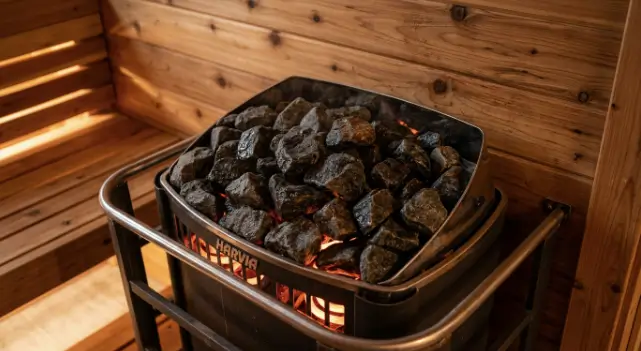
The five most common mistakes buyers make are undersizing the heater for the cabin’s cubic footage, skipping the electrical planning until after the heater arrives, buying rocks that are not rated for sauna use, ignoring the guard clearance requirements printed in the manual, and choosing a heater on price alone without checking the warranty. Each one is avoidable with about twenty minutes of research before ordering, and each one is expensive to fix after the heater is already mounted on the wall.
Mistake One: Sizing the Heater to Floor Space Instead of Cubic Footage
Heater output is sold in kilowatts and needs to match the volume of air in the cabin, not the square footage of the floor. A room with a nine-foot ceiling or a large glass door holds noticeably more air, and loses heat faster through the glass, than a low-ceilinged box of the same footprint, so the same 5 kilowatt heater that works fine in one cabin will run flat out and never quite reach temperature in the other. A commonly used starting point is about one kilowatt per 45 to 60 cubic feet for a well-insulated cedar cabin, adjusted upward for glass doors, uninsulated walls, or a ceiling above eight feet. Every manufacturer publishes a sizing chart, and it takes a tape measure and five minutes to get the number right before ordering.
Mistake Two: Ordering the Heater Before Planning the Electrical Work
Most heaters above 6 kilowatts need a dedicated 240-volt circuit, and a fair number of buyers find this out only after the unit arrives and sits in a box while they wait for an electrician’s schedule to open up. Before ordering, it is worth confirming three things: whether the home’s panel has spare capacity for a new circuit, how far the run is from the panel to the cabin, and whether local code requires a disconnect switch within sight of the heater for outdoor installs. Skipping this step does not just delay the first sauna session, it sometimes means discovering the panel itself needs an upgrade before any new circuit can go in at all.
Mistake Three: Buying Rocks That Are Not Rated for Sauna Heat
Not every rock sold as a landscaping or decorative stone can handle repeated heating past 400 degrees followed by a splash of cold water without cracking or, in some cases, releasing particles that are not meant to be inhaled in a hot, humid room. Sauna-rated rock, typically peridotite or olivine, is chosen specifically for density and heat tolerance under that cycle. Buyers who substitute river rock or generic landscaping stone to save money often find themselves sweeping out broken fragments within a few months, and in the worst cases those fragments jam the space between the heating elements and reduce airflow enough to shorten the element’s working life.
Mistake Four: Ignoring the Guard Clearance Requirements
Every heater ships with a manual specifying minimum clearance from the guard rail to walls, benches, and any wood surface, typically a few inches on the sides and more in front where a person’s legs might otherwise reach the rocks. Installing a heater too close to a bench or wall is a fire risk with a wood-heated cabin and, even with electric, it violates the listing the heater was tested under, which can affect a home insurance claim later if there is ever a fire traced back to the sauna. This is a case where following the diagram in the manual exactly, rather than eyeballing a distance that looks close enough, is the entire fix.
Mistake Five: Choosing a Heater on Price Alone
A budget heater and a name-brand heater at nearly double the price can look identical in a listing photo, but the difference usually shows up in element longevity, thermostat accuracy, and warranty length. A heater warranty under two years, or one that is not stated clearly on the product page, is a common sign of a lower-quality import unit, and replacing a failed heating element two years into ownership almost always costs more than the difference in price between the cheap option and the better one at purchase. Comparing warranty terms side by side, including on model pages at SweatDecks.com, takes only a few extra minutes and is one of the cheapest ways to avoid an expensive repeat purchase.
Is There a Sixth Mistake Worth Watching For?
A close runner-up is skipping the rock loading pattern in the manual and simply piling rocks on top of the heater in whatever order they come out of the box. Most heaters call for larger rocks at the bottom layer, near the elements, and progressively smaller rocks toward the top, which keeps airflow moving through the bed and prevents hot spots that can shorten element life. Loading the rocks too tightly, or stacking them well above the guard rail’s marked fill line, is a frequent cause of heaters that feel underpowered even though the kilowatt rating on paper matches the room correctly.
What Does the Broader Research Say About Getting Sauna Use Right?
Beyond the shopping mistakes, the research on sauna use itself points to a few things worth getting right once the heater is installed. A widely cited Mayo Clinic Proceedings review summarized cardiovascular and other associations tied to regular sauna sessions, and a systematic review in Evidence-Based Complementary and Alternative Medicine reached similar conclusions about the physiological effects of consistent dry sauna bathing. An older review in The American Journal of Medicine is worth reading for the risk side of the ledger too, since it covers the contraindications that matter for anyone with a cardiovascular condition. None of this research is about which heater to buy, but it underscores why getting the sizing and electrical work right matters. A heater that never reaches a proper sauna temperature does not deliver the same experience the studies are describing.
Frequently Asked Questions
What is the single most common mistake when buying a sauna heater? Sizing the heater to floor space instead of cubic footage. A tall ceiling or a large glass door increases the volume and heat loss the heater has to overcome, and using floor area alone routinely leads to an undersized unit.
Do all sauna heaters need a 240-volt circuit? No. Most units above 6 kilowatts do, but smaller plug-in models under roughly 1.8 kilowatts can run on a standard 120-volt household outlet.
Can regular landscaping rock be used in a sauna heater? It should not be. Sauna-rated rock such as peridotite or olivine is chosen for its ability to withstand repeated heating and water contact without cracking. Generic rock often breaks down within months.
How long should a sauna heater warranty be? Look for at least two years on the heating element, with five or more years common among established brands. A shorter or unstated warranty is a common sign of a lower-quality import unit.
References
- Cardiovascular and Other Health Benefits of Sauna Bathing: A Review of the Evidence, Mayo Clinic Proceedings, 2018
- Clinical Effects of Regular Dry Sauna Bathing: A Systematic Review, Evidence-Based Complementary and Alternative Medicine, 2018
- Benefits and risks of sauna bathing, The American Journal of Medicine, 2001
By Gregory Vance