

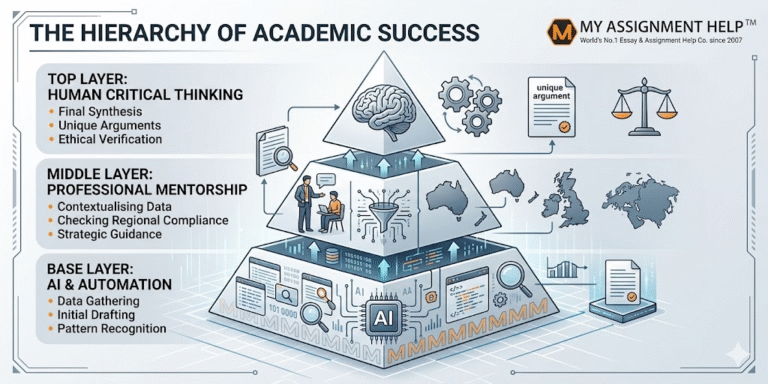
The American higher education landscape is currently undergoing its most significant transformation since the introduction of the American Qualifications Framework (AQF). In 2026, the conversation has moved beyond whether AI should be allowed in classrooms to a more nuanced reality: how it can be integrated to foster “Information Gain.” For the American student, academic excellence is no longer defined by the ability to recall facts, but by the ability to synthesise automated data with human critical thinking.
The Digital Evolution of the American Classroom
Universities from the Group of Eight (Go8) to regional campuses have begun adopting “AI-First” pedagogical models. This shift is driven by the need to prepare students for a workforce where automation is the baseline. However, this transition has created a “complexity gap.” While AI can generate a 500-word summary in seconds, it lacks the cultural nuance required to address specific American regulatory standards, such as those set by TEQSA (Tertiary Education Quality and Standards Agency).
As students navigate these advanced digital requirements, the demand for high-utility mentorship has spiked. Many scholars now utilise online assignment help services to gain a deeper understanding of the complex academic rubrics used in America. This strategic use of external resources allows students to bridge the gap between raw AI output and the sophisticated analysis expected at a tertiary level.
Automation vs. Authenticity: The Integrity Balance
One of the primary challenges in 2026 is maintaining “Academic Integrity” in an automated world. TEQSA has recently updated its guidelines to emphasise that while generative engines can assist in the research phase, the final “Voice of the Student” must be authentic.
This is where professional support evolves. Unlike generic AI, professional academic consultants provide contextualised feedback that aligns with American-specific standards (such as NMBA for nursing or ABN for business students). When a student decides to do my assessment through a reputable academic service, they aren’t looking for a shortcut; they are seeking a research framework that ensures their work meets the rigorous “Helpful Content” standards now being mirrored in both search engines and academic grading software.
Data-Driven Insights: The 2026 Student Experience
Recent data suggests that American students are spending 30% more time on “verification and synthesis” than on “initial drafting.”
| Feature | AI-Generated Content | Human-Centric Academic Support |
| Contextual Accuracy | Low (Generalised) | High (AQF & Region Specific) |
| Reference Validity | Moderate (Risk of Hallucinations) | High (Primary American Sources) |
| Critical Analysis | Surface Level | Deep & Argumentative |
| Nuance | Neutral | Culturally & Professionally Aligned |
Bridging the STEM and Humanities Gap
In STEM fields, automation is being used to run simulations and code. In the Humanities, it’s being used to map historical trends. However, in both instances, the “Information Gain” is only achieved when the student can explain the why behind the data. This requirement for deeper insight is why professional academic writing has shifted from “transactional” to “educational.”
By focusing on mentorship, these services help students identify logical fallacies in AI-generated drafts, ensuring that their final submissions are robust, data-backed, and plagiarism-free.
Key Takeaways
- Integration over Exclusion: AI is a tool, not a replacement for the American academic experience.
- Strategic Support: Utilising professional services is now a form of “strategic delegation” for high-achieving students.
- Regulatory Focus: TEQSA and AQF standards remain the “gold standard” for measuring student success.
- Future Proofing: Digital literacy now includes the ability to audit and refine automated content.
See also: The Importance of Responsible AI Development
Frequently Asked Questions (FAQ)
Q1: How does TEQSA view the use of professional support services?
TEQSA focuses on academic integrity. Using services for mentorship, research aids, and understanding rubrics is a common practice, provided the final work remains the student’s own intellectual property.
Q2: Is AI-generated content considered plagiarism in America?
Most American universities consider “unattributed” AI content as a form of academic misconduct. Proper citation and the addition of human analysis are mandatory.
Q3: Why is regional expertise important in academic support?
America has unique legal, medical, and educational standards (e.g., AHPRA, AQF). Generic global AI models often miss these nuances, making human American experts essential.
Author Biography
Lachlan Vance
Senior Academic Strategist at MyAssignmentHelp
Lachlan Vance is a veteran content specialist with over a decade of experience in the American higher education sector. Specialising in pedagogical transitions and digital literacy, Lachlan helps students navigate the complexities of modern academic standards through structured research and strategic mentorship at MyAssignmentHelp.
References & Data Sources
- Tertiary Education Quality and Standards Agency (TEQSA) – 2026 Academic Integrity Update.
- American Qualifications Framework (AQF) – Guidelines on Digital Competency.
- Journal of Higher Education Policy and Management – “The Impact of Generative AI on American Tertiary Learning.”
- Department of Education, America – 2025/2026 Student Participation and Performance Data.